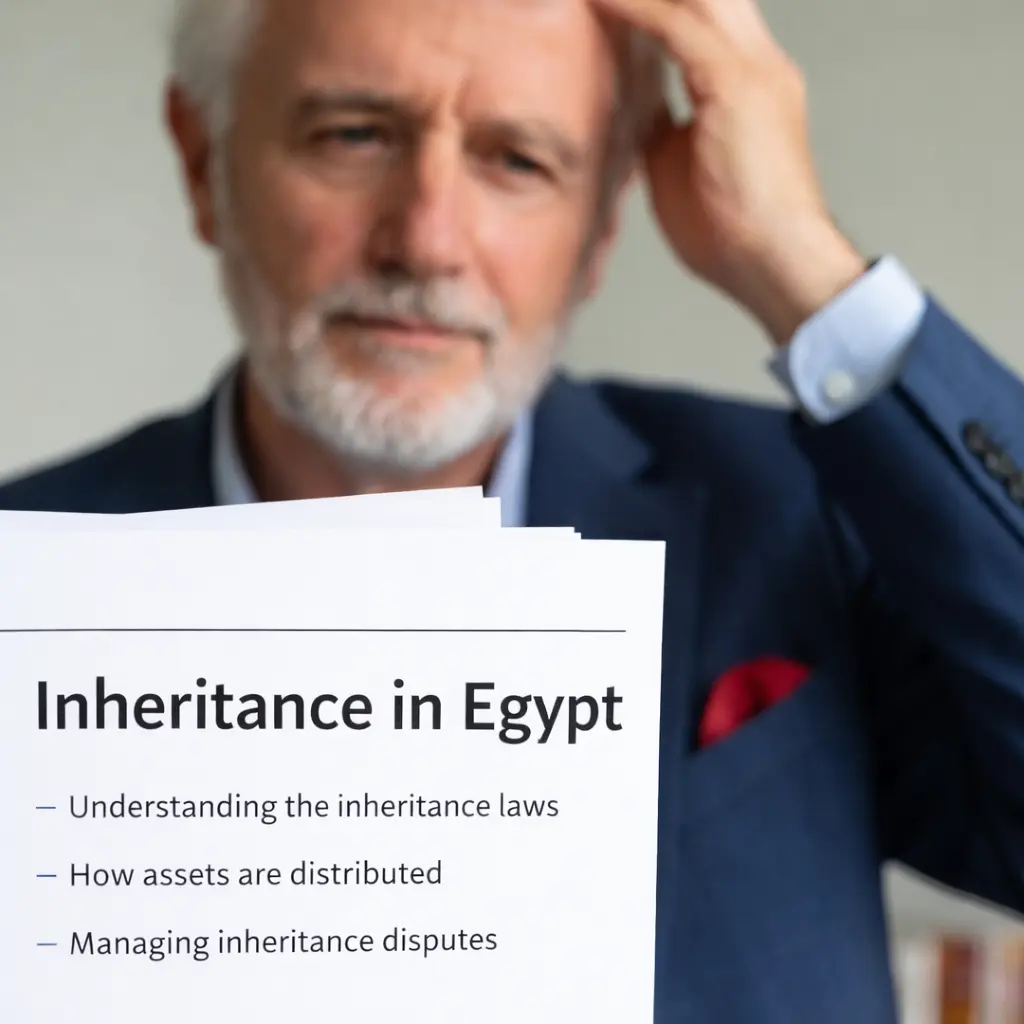
Egypt inheritance support for foreign heirs: inheritance declaration (heirship) file planning, legalisation chain, certified translation, and bank/property release steps
Foreign Heirs • Egypt Inheritance

Egypt Inheritance Support for Foreign Heirs

A practical route-map for heirs abroad—prepare the correct document chain, align translations, and build an inheritance declaration file that can move bank and property assets in Egypt with fewer surprises.

  • Inheritance declaration (heirship) pathway: file structure, sequencing, and court-ready consistency
  • Legalisation chain planning + certified translation checks to prevent mismatch rejections
  • Power of attorney routes for heirs abroad to reduce travel and shorten avoidable delays

We map the case early, flag missing links (names, dates, jurisdictions), and coordinate Egypt-side steps through the lawyers the company cooperates with in Egypt. Scope: Egyptian law only.

Egypt Inheritance Explained

In Egypt, inheritance is not only “who gets what.” The real work is proving heirship in a way that courts and institutions accept, then using that proof to act on assets-bank balances, property interests, shares, or contract rights-without getting stuck on document format and sequencing.

What this guide focuses on

Most timelines are shaped by the first decisive step: an inheritance declaration (often described as the heirship decision) that confirms the lawful heirs. After that, progress depends on clean documentation, consistent names and dates across jurisdictions, and a workable legalisation and translation chain.

This practical guide is written for foreign heirs and cross-border estates. It explains what the inheritance declaration achieves, how foreign documents are handled, and what typically changes when the estate includes Egyptian assets-so you can reduce avoidable delays and prevent technical rejections early.

Egypt Inheritance for Foreign Heirs

For foreign heirs, progress in Egypt is usually driven by readiness: proving heirship in a form that institutions accept, then moving from “rights on paper” to actionable steps for banks, registries, and counterparties-without stalling on technical document issues.

Inheritance declaration (heirship) - the milestone

The first decisive step is typically an inheritance declaration (often described as the heirship decision) confirming the lawful heirs. Banks and registries rely on it before they can process releases, transfers, or changes on Egyptian assets.

Bank account and registry steps - where delays happen

Delays often come from document chain problems: legalisation route, certified Arabic translation, and identity consistency across passports, certificates, and official records. These small mismatches can pause a bank account inheritance file or a registry-facing submission.

Egypt inheritance for foreign heirs — inheritance declaration, document chain legalisation, certified Arabic translation, and bank or registry readiness.
Egypt inheritance for foreign heirs • inheritance declaration (heirship) • document chain legalisation • certified Arabic translation • bank account inheritance • registry release steps • identity consistency across passports and certificates

What to prepare early

  • Align names, dates, and places across all foreign and Egyptian records before filing.
  • Follow the correct legalisation chain so overseas documents are accepted in Egypt.
  • Build a bank/registry-ready pack with clean translations and consistent formatting.

Scope note: Guidance is limited strictly to Egyptian law. Egypt-side procedural steps are handled through the lawyers the company cooperates with in Egypt.

Core Document Pack What to Prepare

While requirements vary by scenario, an administrative inheritance file usually relies on a core document pack. The objective is to establish (i) the death event, (ii) the identity of the deceased and heirs, and (iii) the civil-status links that the inheritance declaration (heirship) process will rely on. In practice, the following items often form the backbone of the file.

Commonly, this includes the death certificate, identity documents for the heirs, and civil-status records that confirm kinship (such as marriage and birth certificates where relevant). Where assets are involved, evidence of the asset base (bank details, property identifiers, or ownership records) helps keep the file execution-ready once heirship is established.

The critical point is not merely possession. Each foreign-issued document must be capable of official use in Egypt, meaning it must meet the correct legalisation route in the issuing country, and it must be translated into Arabic through an accepted process. Strong documents that are not legally usable are, in practice, unusable documents.

Legalisation Chain Apostille, Attestation, MOFA

“Legalisation” is the step that turns a foreign-issued document into a document Egypt can recognise for official use. The exact route depends on where the document was issued and whether an apostille route is applicable. However, the practical rule is consistent: the document must pass through a recognised chain so that its authenticity is accepted by Egyptian authorities.

Why order matters

Many rejections occur not because a document lacks stamps, but because the stamps are in the wrong sequence or are issued by bodies that do not satisfy the recognition pathway. A foreign document may carry multiple seals and still fail acceptance in Egypt if the chain does not meet the expected standard. Treat legalisation as part of the case strategy, not an afterthought.

Practical planning point

Legalisation timelines can meaningfully affect overall delivery time. Families should avoid booking downstream steps in Egypt until the legalisation pathway is confirmed. In practice, weeks are lost when documents arrive in Egypt only to be identified as not yet usable.

Assets in Egypt What Changes in Practice

Real estate requires more than heirship

Egyptian real estate is one of the most complex estate components. Even after heirship is established, transferring or formalising title often requires additional steps: registration, procedural filings, or legal actions depending on how the property is held and documented. This is the stage where practical mistakes can lock assets for long periods, especially when family members are abroad or when the property file itself is incomplete.

Bank accounts and liquid assets follow institutional procedures

Banks and institutions typically require formal proof of heirship and identity before releasing funds or changing records. Foreign heirs should expect formal compliance steps and documentary requirements. The practical strategy is to prepare a complete file early, ensuring the institution receives documentation in the form it is able to accept without repeated back-and-forth.

Disputes often arise from delay and missing records

Many inheritance disputes are not triggered by legal complexity; they are triggered by delay, missing records, or unclear control over documents. Where a family anticipates disputes, it is even more important to move early, document everything, and structure communications and filings carefully. Predictability improves when the file is treated as a controlled process rather than a series of informal family steps.

Fees, Timing and Common Pitfalls

There is no inheritance tax, but there are process costs

Egypt does not operate a general inheritance tax, but estates still carry process costs: court-related fees, legalisation/notarisation for foreign documents, certified legal translation, and—where property is involved—registration-related expenses. Budget for the process (not “tax”) based on the asset mix and the document route.

Most delays are procedural, not legal

Slowdowns usually come from documentary gaps: missing civil-status links, inconsistent spellings, incomplete legalisation, or unclear evidence of assets in Egypt. The practical fix is early structure—confirm what the court/authority will accept, then submit a clean, sequence-ready file.

Withholding documents can escalate disputes

Obstruction often starts with document control. When records are withheld, timelines stretch and disputes harden. Keep copies, log requests, and move early to reduce room for delay tactics.

How We Support Foreign Heirs

We provide practical, supervised support for Egypt Inheritance for Foreign Heirs—asset assessment, document readiness checks, and a clear procedural route with realistic timelines.

Where heirs are abroad, a judicial power of attorney can often remove the need for travel. It can be issued to the lawyers the company cooperates with in Egypt to complete the heirship steps and the agreed actions before the relevant authorities.

We issue a written service assessment setting scope, steps, indicative timing, and fees. The company remains responsible for delivering the agreed scope and coordinating the file.

Important note on client funds and scope

The company does not receive, hold, or manage client funds or assets. Services are limited to Egyptian law matters, with any foreign formalities handled as administrative coordination.

Practical Closing Summary

Treat Egyptian inheritance as a controlled process: establish heirship properly, legalise/translate foreign documents correctly, and plan each asset category—especially real estate and institutional funds. For Egypt Inheritance for Foreign Heirs, predictability comes from early organisation and correct sequencing, not assumptions drawn from other jurisdictions.

If heirs are abroad, a well-drafted judicial power of attorney can keep the file moving efficiently through the lawyers the company cooperates with in Egypt—from proof of heirship to practical release steps.

Foreign Heirs

Inheritance file planning
  • Send death + kinship documents.
  • Get a clear route map + checklist.
  • Move banks/property with less delay.

Foreign Heirs — Egypt Inheritance FAQs

Clear, execution-focused answers for foreign heirs—covering heirship, legalisation/translation, acting from abroad via power of attorney, timelines and common delays, and what you receive as a managed file under Egyptian law.

Begin with clarity

This service page is built for execution. We support foreign heirs by mapping the heirship (inheritance declaration) route, confirming document readiness, and planning the legalisation and translation chain so bank and property steps in Egypt can move with fewer delays and fewer “surprise requirements.”

Scope note: Guidance is limited strictly to Egyptian-law matters. Egypt-side procedural steps are handled through the lawyers the company cooperates with in Egypt. This service does not constitute UK legal services, and the company does not receive, hold, or manage client funds or assets.


Trusted by Clients Worldwide

Real feedback from verified Google reviews worldwide.

Our clients value clear communication, accurate legal guidance, and consistent follow-through.
These reviews reflect real experiences from international clients who relied on structured, professional legal support related to Egypt.

Navigate Legal Matters with Confidence

We provide structured legal support focused exclusively on Egyptian law, assisting international clients and professionals with Egypt-related legal matters.

Contact Information

Company Information

Anglo-Nile International Legal Services Ltd. All rights reserved 2025 ©